When you’re painting a single living room, a roller and a free Saturday can get it done. When you’re painting a million-square-foot warehouse, a hospital wing on a tight schedule, or a 30-story multifamily tower, the rules change. Throughput, consistency, and safety matter as much as color. That’s where automated paint systems earn their keep. They’re not just fancy sprayers; they’re an integrated way of working that turns chaos into a predictable process. For any team offering truly professional paint services, large projects simply run better with large-scale painting automation.
What “Automated” Really Means in Painting
Automation in our world isn’t only about robots in a factory. On construction and facilities jobs, it looks like high-output airless rigs with digital pressure control, long-hose pump systems that feed multiple guns at once, proportioners that automatically mix two-component epoxies to exact ratios, line-stripers that follow laser or GPS guides, conveyorized finishing for doors and trim, and software that logs film thickness, temperatures, and crew output in real time. Put simply: fewer manual variables, more controlled results.
That matters because big jobs magnify small problems. A pressure setting that’s “close enough” on a small space becomes gallons of wasted paint across a stadium. Automation tightens the tolerances so your outcome doesn’t depend on luck or heroics.
Speed Without the Mess
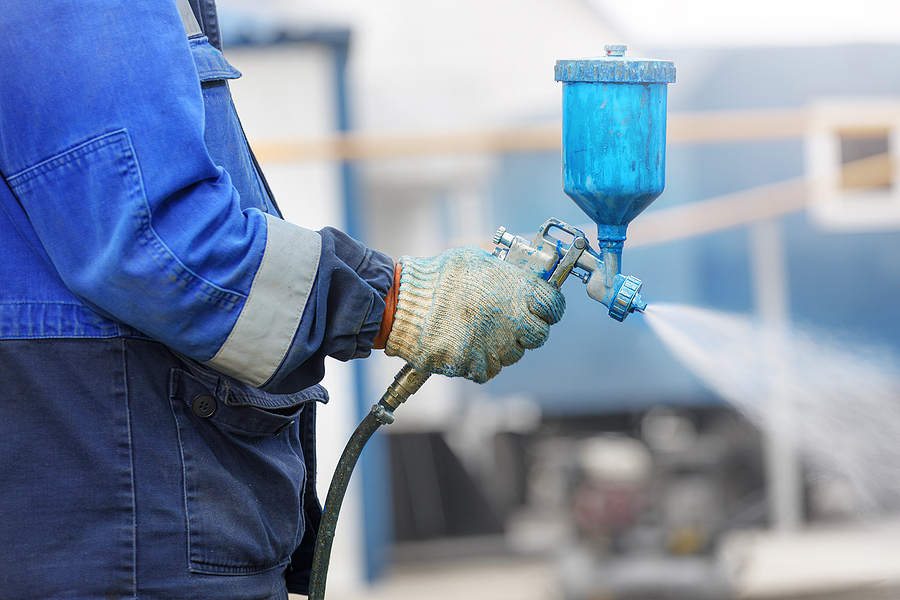
Output is the headline benefit. Automated paint systems move more material, more evenly, with less fatigue. A pump-fed airless rig can keep consistent pressure to two or three guns at once, so crews cover broad walls and ceilings in coordinated passes.
Digital regulators keep atomization steady as tips wear, so the last room looks like the first. When you scale that across hundreds of units or acres of concrete tilt-wall, the time savings are huge, and so is the quality.
Speed doesn’t mean sloppy. Because pressure and tip size are controlled, atomization is cleaner and overspray is reduced. On high-ceiling production spaces or parking structures, that means less masking, less drift, and fewer touch-ups. On occupied healthcare or education projects, it means cleaner edges and less disruption to staff and students.
Consistency You Can Prove
Owners and GCs don’t just want a great finish; they want documentation. Today’s rigs and gauges help you deliver both. Crews can log daily settings, batch numbers, surface temperatures, relative humidity, and dry film thickness (DFT) by area. That creates a QA trail that satisfies specifications and warranties. If a question comes up six months later—about coverage, sheen, or adhesion, you’re not guessing. You have the data.
Automated proportioners shine on specialty coatings. Two-component epoxies and urethanes perform beautifully when they’re mixed exactly at the point of application. Manual mixing invites error; automated proportioning tracks ratios, pot life, and hose temperatures, so you hit spec on every pass. The result is fewer callbacks, fewer holidays, and finishes that live up to their service life.
Safer, Smarter Labor
Large projects can strain even deep labor benches. Automation helps your best painters do more while staying safer. Long-reach poles, remote pressure controls, and stable spray patterns mean less time on ladders and less repetitive strain. When you can feed three guns from one pump, crews move like a choreographed team, one focuses on cutting and detail, two on broad coverage, without downtime for constant bucket changes or tip fiddling.
Safety isn’t just a slogan. With automated tools, painters spend more time on stable platforms and scissor lifts instead of climbing up and down. Heat and humidity sensors help decide when to pause so coatings don’t fail. Line-stripers put layout lines where they belong on the first pass, keeping crews out of traffic lanes longer than necessary. It’s the kind of everyday risk reduction that adds up across months on site.
Better Material Efficiency (and Lower Total Cost)
Paint is expensive, especially high-performance systems. Automation wrings more value from every gallon. Controlled atomization improves transfer efficiency, which means more coating on the wall and less in the air. Accurate mixing reduces waste with two-component products. Consistent mil thickness prevents the two classic budget drains: over-application (burning material) and under-application (rework).
Total cost is bigger than a material line. Every hour you don’t spend remasking, remobilizing, or reworking is an hour the electrician, millworker, or flooring crew gets back. That schedule buffer is worth real money to owners and builders. It’s also the difference between “on time and calm” and “on time and exhausted.”
Cleaner Jobsites and Easier Compliance
Many specifications and municipalities now require low-VOC products, documented DFT, and controls for overspray and cleanup. Automated paint systems make compliance easier. Smart tips and pressure control lower airborne mist. Enclosed or semi-enclosed spray areas for shop finishing capture more material. Proportioners and pumps reduce open-bucket handling, so there’s less chance of spills.
On maintenance contracts, automation supports night and weekend work without drama: tidy rigs, fast setup, consistent results, predictable cleanup. For schools, hospitals, and retail, that’s how you paint around people without feeling like you’re painting around people.
Where Automation Makes the Biggest Difference
- Warehouses and Logistics Centers: Tall bays, long runs, and a lot of square footage. Multi-gun rigs and lift-friendly spray setups let you coat ceilings, deck, and walls quickly with uniform sheen.
- Healthcare and Labs: Tight specs on low-VOC, scrubbable coatings and finite shutdown windows. Automated mixing and logged DFTs deliver repeatable, certifiable results.
- Multifamily and Hospitality: Repetition with variation—hundreds of units, but each with its quirks. Automation keeps color and sheen consistent across floors, corridors, and amenities, even as the plan changes.
- Education and Civic: Big walls, strict schedules around semesters, heavy wear. Spray where it makes sense, soft-wash and roll where it doesn’t, all coordinated by rigs and software that keep output steady.
- Parking Decks and Line Striping: Laser-guided or GPS-assisted stripers create crisp lines and symbols the first time. Moisture and temperature monitors prevent coating failures on cool concrete.
Preparation and Finishing Still Matter
Automation isn’t a magic eraser. Surfaces still need to be clean, sound, and profiled to spec. The difference is that prep can be systematized too. Dust extraction, power washing, vacuum-attached sanding, and moisture testing create a repeatable handoff to spraying. On the back end, finishing touches, back-rolling where required, fine cutting at transitions, cabinet and door finishing in a controlled shop line, close the loop so the whole project reads as one hand.
How to Vet a Contractor for Large-Scale Painting Automation
Ask a few pointed questions and the picture becomes clear fast:
- What pump capacity and hose lengths do you run for large interiors, and how many guns can you feed at spec pressure?
- Do you use automated or assisted proportioners for two-component coatings? How do you document ratios and temperatures?
- How do you log DFT, RH, and substrate temperature? Can you share sample reports?
- What’s your plan to control overspray in occupied or partially open areas?
- How do you set lift workflows and fall protection for high coverage work?
- What’s your approach to shop finishing for doors, casework, and millwork—and how do you protect pieces in transit?
The answers will tell you whether a provider offers true professional paint services or just “more people with more rollers.”
A Quick Reality Check: Does Automation Replace Craft?
No. It amplifies it. Great painters still make great decisions, about sequence, lighting, edges, and how to make a space feel finished. Large-scale painting automation takes the heavy lift of moving gallons across acres and turns it into a controlled process. That frees the craft to focus on details people notice: clean cuts, uniform sheen, and a space that looks intentional from the lobby to the loading dock.
The Payoff Owners and Builders Care About
When automation is built into the plan from day one, you get measurable benefits: shorter schedules, fewer punch-list items, lower rework, tighter cost control, and documentation that survives turnover. Facilities teams inherit a finish that’s on spec and easier to maintain. Tenants move into spaces that look right under real lighting, not just in photos. And the painting phase becomes the part of the job nobody has to worry about.
Ready to bring automation to your next project?
If you want the speed, consistency, and documentation that automated paint systems deliver without losing the human touch, bring in a team that does it every day. Bethel Stone Painting and Carpentry builds large projects around automation: multi-gun airless rigs, automated proportioning for specialty coatings, shop finishing lines for doors and millwork, and QA tools that prove what we’ve done. That’s how we keep promises on tight timelines and complex specs.
Let’s talk about your scope and schedule, and design the right plan for your site. Reach out to Bethel Stone Painting and Carpentry today, and we’ll bring true large-scale automated paint systems to your project, delivering the kind of finish you can see, schedule you can trust, and documentation you can keep.